.
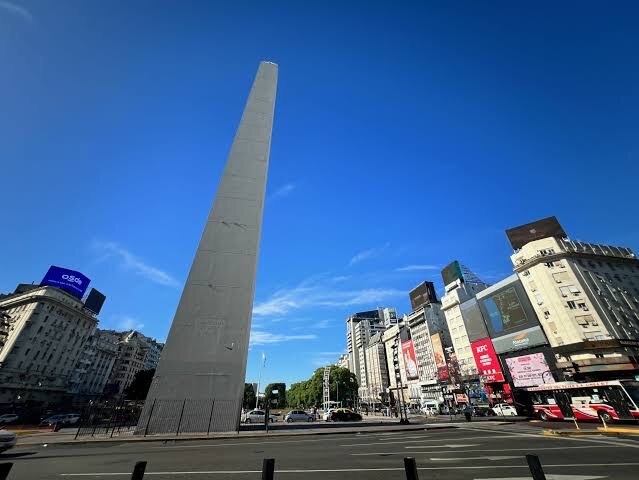
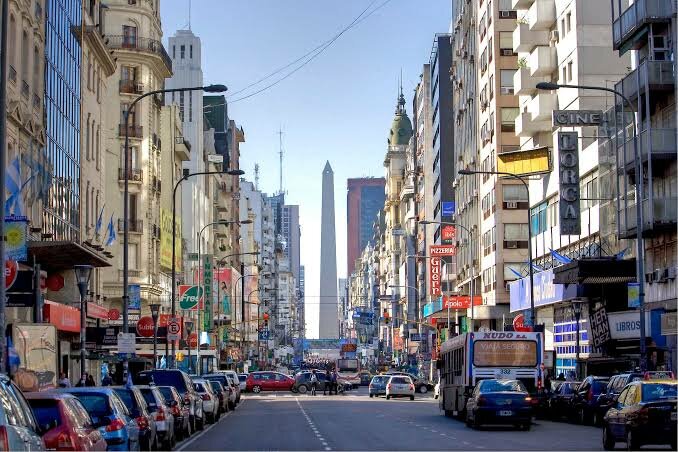
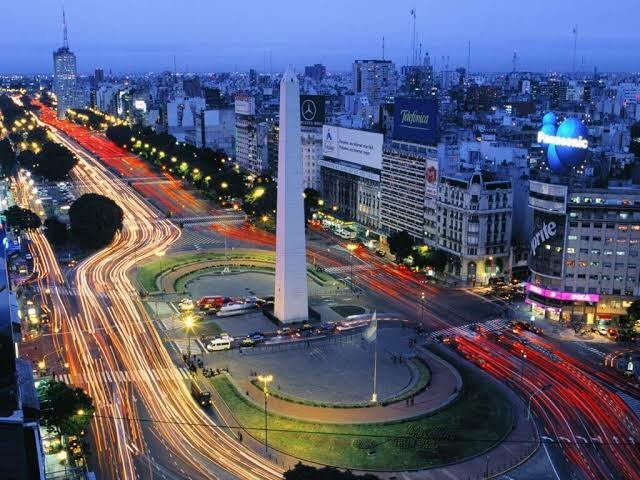
Believe it or not, few monuments in Argentina sparked as much backlash at birth as the Obelisk. Today it’s impossible to think of Buenos Aires without this white silhouette marking the crossing of Corrientes and 9 de Julio, but when it was inaugurated, in 1936, much of the city saw it as an unnecessary exaggeration.
The story of the Buenos Aires Obelisk has it all: a lightning-fast build, a formal attempt to demolish it and, almost ninety years later, a symbol no one questions. In this article we tell you a bit about how this story unfolded. Keep reading!
Why the Obelisk was built
The Obelisk was born as part of the celebrations for the fourth centenary of the first founding of Buenos Aires, carried out by Pedro de Mendoza in 1536.
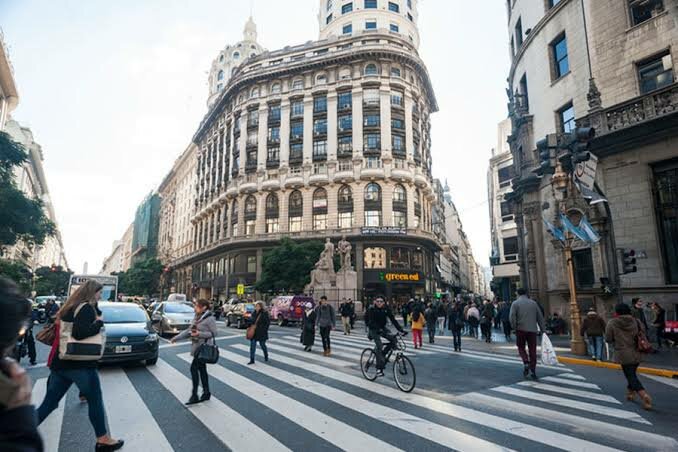
The city was then undergoing a deep urban transformation. Avenida Corrientes was being widened, the opening of Diagonal Norte was moving forward, and Avenida 9 de Julio was beginning to take shape.
In that context, the authorities were looking for a monument capable of representing the new Buenos Aires.
The site wasn’t chosen at random either.
On the plot where the Obelisk stands there had been the church of San Nicolás de Bari. From its tower the Argentine flag was raised for the first time in Buenos Aires, in 1812. The church was demolished during the works to open Avenida 9 de Julio, and one of the monument’s inscriptions recalls that event.
The project was entrusted to architect Alberto Prebisch, one of the leading representatives of Argentine modernism and also the author of the Gran Rex Theatre, located on Avenida Corrientes.
How the Obelisk was built
Work began in March 1936 and the monument was inaugurated on May 23 of that same year.
Construction was completed in an extraordinarily short time. Official sources agree that 157 workers took part and that the job was finished in about two months; the current tourist sheet highlights 31 days of effective execution.
Reinforced concrete and quick-setting cement were used, which made it possible to move quickly with the structure.
The result was a monument 67.5 meters tall, with a base 6.8 meters per side and an approximate weight of 170 tons.
It has a single access door, facing west onto Avenida Corrientes, and four windows at the top, one toward each cardinal point.
Before the installation of the current elevator, to reach the summit you had to climb an interior ship’s ladder of 206 steps and seven landings.
Why they wanted to demolish it
It’s hard to believe today, but the Obelisk didn’t go over well at first. It arrived in a Buenos Aires that still embodied late-19th-century European architecture. For that very reason, its simple, monumental geometry drew criticism from the day it was inaugurated.
On top of that came another problem: the monument originally had a cladding of white calcareous stone slabs, and in 1938 fragments began to come loose. Aesthetic criticism then found a stronger ally: concern for safety.
In June 1939, the City Council approved Ordinance 10,251 to demolish it, with an overwhelming vote: 23 in favor, only one against. Aesthetic, economic and safety reasons were all mixed together.
But it was right then that it was saved by a veto. President Roberto Ortiz stepped into the discussion, and Mayor Arturo Goyeneche ended up vetoing the ordinance. To the joy of few, the Obelisk stayed.
In the end, the cladding problem was solved by removing the slabs and covering the structure with plaster (in fact, the look we know today is a legacy of that mishap). And so, what many saw as an out-of-place structure slowly began to blend into Buenos Aires’ cityscape.
From disputed monument to city symbol
As the decades passed, exactly the opposite of what its detractors had imagined happened.
The Obelisk stopped being simply a commemorative monument and became the place where Buenos Aires often expresses its collective events.
Sporting celebrations, demonstrations, concerts and public events had Plaza de la República and Avenida 9 de Julio as their stage.
It also came to serve as a platform for artistic interventions and public campaigns.
One of the most remembered took place on December 1, 2005, when it was covered with a structure that simulated a huge condom as part of a campaign for World AIDS Day.
Ten years later came one of its most ingenious artistic interventions.
In 2015, Argentine artist Leandro Erlich presented The Democracy of the Symbol. The Obelisk’s summit was covered with a structure that created the illusion that the tip had disappeared, while a full-scale replica could be visited next to MALBA.
The work played precisely with something that was already evident: by then, visually removing the Obelisk’s tip was enough to alter one of Buenos Aires’ most recognizable images.
The Obelisk today: a monument you can also visit
For almost nine decades, the interior of the Obelisk was practically reserved for technical tasks and exceptional visits.
That changed in 2025.
Since November 1, 2025, the Obelisk Lookout has been operating regularly, allowing visitors to enter the monument and reach its upper section via an elevator installed inside the structure.
The elevator has one glass side and goes up to a level just below the summit. From there, a 35-step spiral staircase leads to the lookout’s four windows. The full experience lasts about 20 minutes.
As of August 2026, tickets are sold online and there are extended hours on some days of the week. Since both prices and schedules can change, it’s best to check the official information before planning your visit.
It’s an important change in the monument’s history: what for decades could only be seen from below can now also be experienced from the inside.
Quick facts about the Buenos Aires Obelisk
Location: Plaza de la República, intersection of Avenida Corrientes and Avenida 9 de Julio.
Inauguration: May 23, 1936.
Reason: fourth centenary of the first founding of Buenos Aires.
Architect: Alberto Prebisch.
Height: 67.5 meters.
Base: 6.8 meters per side.
Approximate weight: 170 tons.
Workers: 157.
Original staircase: 206 steps and seven landings.
Demolition attempt: June 1939.
Vote: 23 votes in favor of demolishing it and 1 against.
Veto: Mayor Arturo Goyeneche.
Lookout open to the public: since November 2025.
See the Obelisk from another perspective
History changes quite a bit when you go out into the street and see it there, planted in the middle of the city that ended up growing around it.
HR Luxor is a hotel 150 meters from the Obelisk, on Avenida Roque Sáenz Peña, and about 100 meters from Corrientes and Avenida 9 de Julio, practically at the same intersection. Our hotel also has a rooftop with a panoramic view of the monument, ideal for seeing it without leaving the hotel.
From there it’s easy to walk much of the microcentro and run into the Obelisk again and again—by day, by night, from different angles—each time with a different postcard view. And if you’re coming with a group, HR Luxor has group accommodation in downtown Buenos Aires 150 meters from the monument.
If you want to plan the walk, continue with our article on what to do near the Obelisk.
We invite you to stay 150 meters from the Obelisk at HR Luxor and discover downtown Buenos Aires from one of its most iconic points. You can see the available rooms and book directly on the website.